

After a master in life sciences at the EPF in Lausanne, Switzerland, I wanted to keep working in an interdisciplinary field, so I chose to do a Ph.D. (or, more exactly, a Dr. rer. nat.) in systems immunology. Working in two labs, one theoretical, the other experimental, allowed me to combine an experimental approach to a modelling approach, and to learn how to integrate the two aspects of biological research. The combination of experimental and computational work is important, and communication difficulties between the two fields are a non-negligible impairment in biological research. My position at the intersection of both fields allows me to reduce those difficulties by understanding both the data requirement of system biologists, the experimental needs of experimentalists, and by being able to explain mathematical models in biological terms and biological restrictions in practical terms.
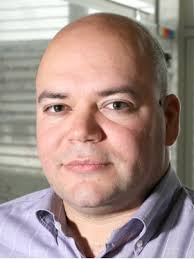
Matteo Dal Peraro graduated in Physics at the University of Padua in 2000. He obtained his Ph.D. in Biophysics at the International School for Advanced Studies (SISSA, Trieste) in 2004. He then received postdoctoral training at the University of Pennsylvania (Philadelphia) under the guidance of Prof. M. L. Klein. He was nominated Tenure Track Assistant Professor at the EPFL School of Life Sciences in late 2007. His research at the Laboratory for Biomolecular Modeling (LBM), within the Interfaculty Institute of Bioengineering (IBI), focuses on the multiscale modeling of large macromolecular systems.